
☁️ CTA Knowledge Bytes #4 - Salesforce Application Architecture
Understanding the big picture is critical before diving into technical details. A 50,000-foot view every CTA must master
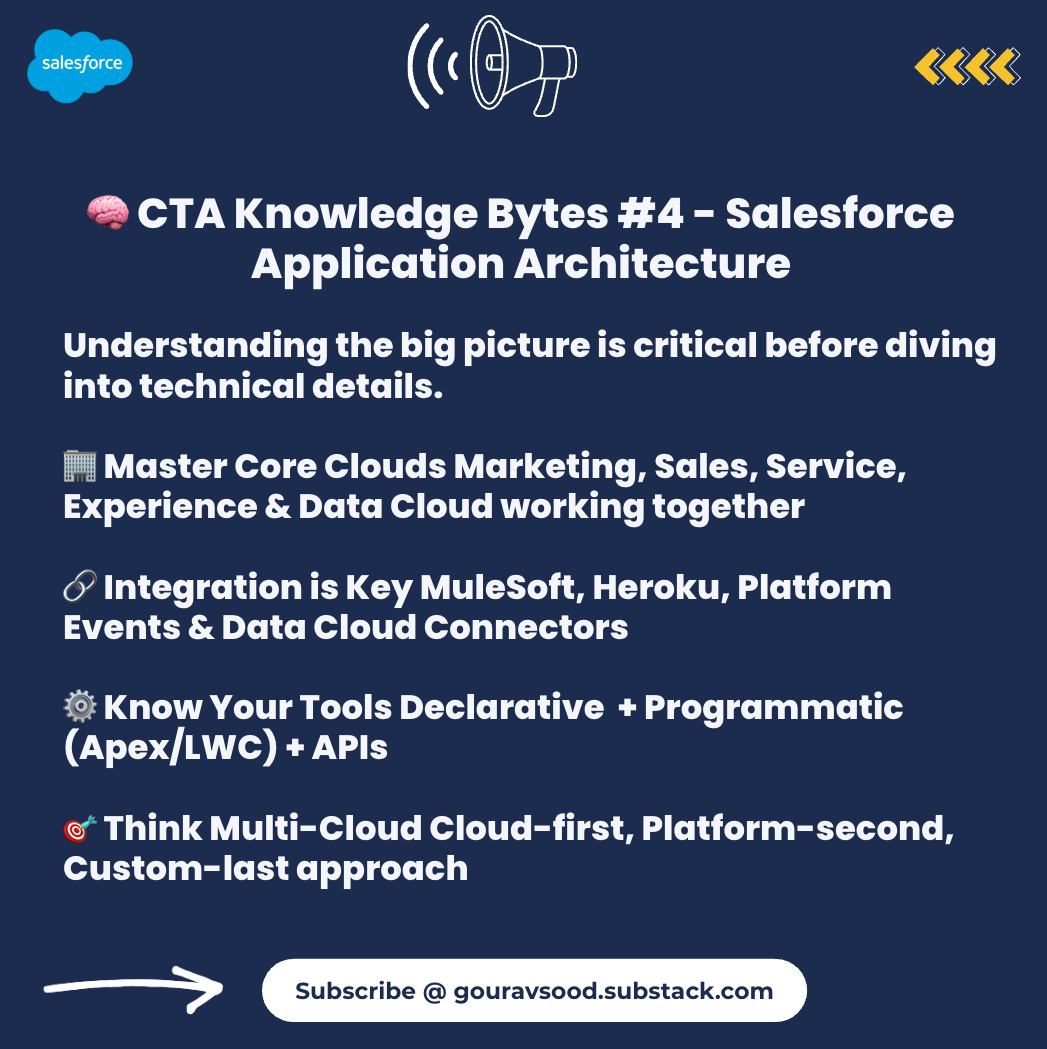
Understanding the big picture is critical before diving into technical details. A 50,000-foot view every CTA must master.
🏢 Core Clouds & Their Purpose:
Marketing Cloud: Journey orchestration, email campaigns, personalisation
This is where the end customer journey starts with Multi-channel engagement: Email Studio, Mobile Studio, Social Studio, Advertising Studio
Sales Cloud: Lead-to-Cash processes, opportunity management, forecasting
This is where prospects get qualified through the sales funnel
Journey: Lead → Opportunity → Quote → Order → Contract → Asset
Service Cloud: Case management, omnichannel support
This is where customers get support for their purchased products
Omnichannel routing across email, chat, phone, messaging, and social
Knowledge management and self-service portals
Einstein Bots for automated case deflection and resolution
Experience Cloud: Customer, partner, and employee portals
Branded digital experiences built on Salesforce Platform
Self-service capabilities reducing support burden
Partner onboarding and collaboration hubs
Data Cloud: Unified customer profiles, real-time segmentation, data harmonization
The connective tissue for enterprise data strategy
Real-time customer data platform (CDP) capabilities with 200+ out-of-box connectors to external systems
Zero-copy architecture for data lake integration
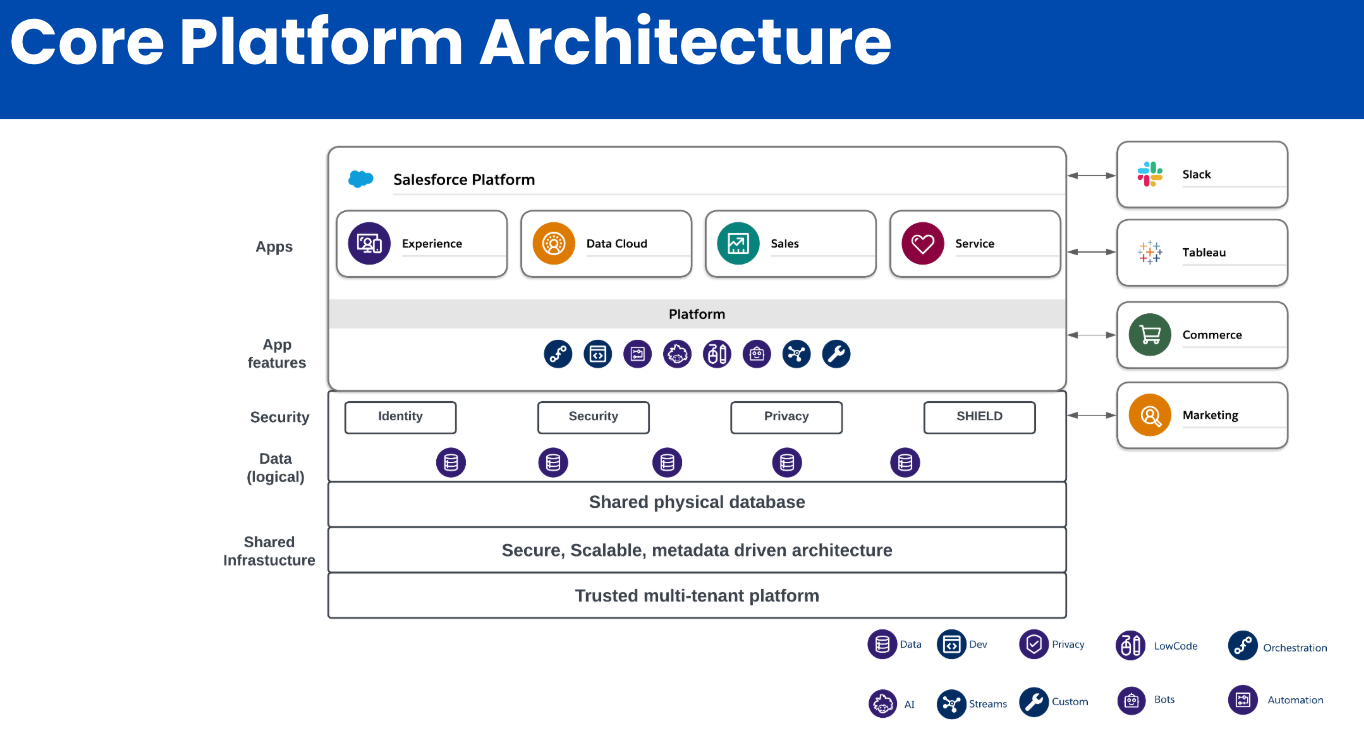
🔗 Enterprise Integration Layer:
MuleSoft: API-led connectivity, system integration
Heroku: Custom apps, microservices, external databases
Marketing Cloud Connect: Sync Sales/Service data with Marketing journeys
Data Cloud Connectors: Enterprise data lake integration
Integration Platform Services:
External Services: Declarative integration with REST APIs
Platform Events: Event-driven architecture within Salesforce
Change Data Capture: Subscribe to data changes in real-time
Streaming API: Push notifications for record changes
⚙️ Platform Development Capabilities:
✅ Declarative Tools (Low-Code/No-Code): Flow Builder, Process Builder, Lightning App Builder
✅ Programmatic Options (Pro-Code): Apex, Lightning Web Components (LWC), Aura Components, Visualforce Pages
✅ Data Management: SOQL, SOSL, DML operations, Bulk API
✅ Security Framework: Profiles, Permission Sets, Sharing Rules, Field-Level Security and more
✅ Integration APIs: REST, SOAP, Bulk, Streaming, Platform Events and more
✅ Automations: Triggers, Scheduled Jobs, Queueable Apex, Batch Apex
✅ UI Framework: Lightning Design System, Dynamic Forms, Record Pages
🎯 CTA Architectural Principles:
📌 Think “Cloud-first, Platform-second, Custom-last” - Leverage native cloud capabilities before building custom solutions
📌 Modern Salesforce architecture is about orchestrating multiple clouds and connecting enterprise data, not just customising a single Salesforce Cloud
📌 Don’t architect in silos! Modern solutions leverage MULTIPLE clouds with Data Cloud as the integration layer. The platform capabilities are your force multipliers
#CTAKnowledgeBytes #SalesforceArchitecture #EnterpriseArchitecture #AI #Agentforce
Salesforce | Salesforce Architecture Talk | Salesforce Partners | Salesforce Architects | Salesforce Admins | Salesforce Developers